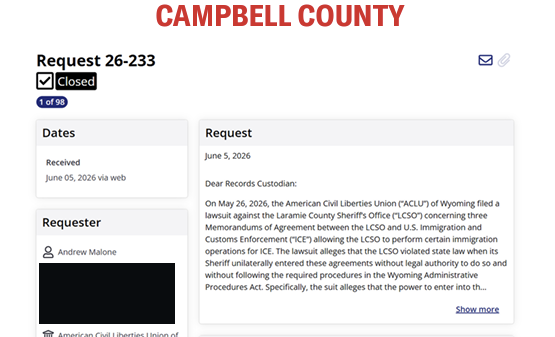
After filing our lawsuit in Laramie County, the ACLU of Wyoming filed public records requests with the 7 other counties that have active 287(g) agreements with U.S. Immigration and Customs Enforcement as well as the Wyoming Highway Patrol.
Specifically, we asked Campbell, Carbon, Crook, Hot Springs, Lincoln, Natrona and Sweetwater Counties – each of which has one or more active 287(g) agreements with ICE – for records showing that their county governing bodies officially sanctioned the decision to participate in the 287(g) program. Additionally, we sought records showing that the counties and the Wyoming Highway Patrol complied with the rulemaking process in the Wyoming Administrative Procedures Act before entering into the 287(g) agreements.
In response to public record requests, the ACLU of Wyoming has discovered:
- Campbell, Hot Springs, Lincoln and Natrona counties were unable to produce any records showing that the agreements had been considered or approved by the county commissioners before they were adopted by their sheriffs.
- Carbon County Commission officially sanctioned the decision to participate in the 287(g) program after being presented with information from Carbon County Sheriff Alex Bakken in 2025
- In Crook County, records show that in 1998, the board of commissioners adopted a resolution granting the county sheriff the authority to enter into agreements with other law enforcement agencies.
- And in early July 2026, the Sweetwater County Commission passed a resolution retroactively ratifying all agreements former Sheriff John Grossnickle unilaterally entered into with ICE since 2020.
- None of the counties or the Wyoming Highway Patrol have records of WAPA compliance.
When it comes to decisions that affect our communities so drastically like this, Wyomingites deserve a transparent, democratic process. But that hasn’t happened. Instead, laws have been applied inconsistently across the state. This is unacceptable. As the highest elected law enforcement officer in the county, sheriffs must be held accountable to their communities.
View copies of the public record request responses by clicking the link below.