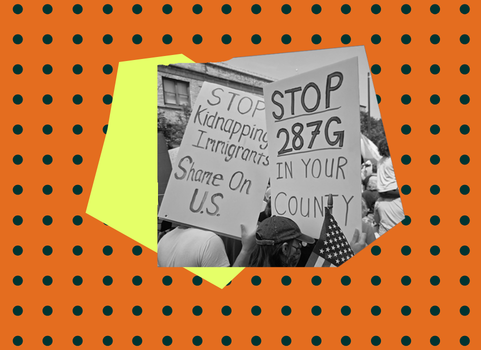


When it comes to decisions that affect our communities, Wyomingites deserve a transparent, democratic process. Sheriffs cannot exercise unchecked authority to make decisions that harm our neighbors, family members, and friends. Wyoming sheriffs aren’t above the law.
Strong, safe communities are built on mutual respect and trust – not ripped apart by a flawed, inhumane and arbitrary immigration agenda.
Join our efforts to fight back.
Last updated on May 27, 2026
As the federal government continues to ramp up ICE operations, local police and sheriff’s departments are being converted into arms of its deportation machine – and they’re using 287(g) agreements to do it.
A shared culture of self-reliance. Hard work. Neighborly kindness.
In Wyoming, we respect each other’s freedoms while looking out for people when they’re in need.
But in communities across the state, local law enforcement officials have been sending an unmistakable message: Your friends and neighbors could be a target.
As the federal government continues to ramp up ICE operations, local police and sheriff’s departments are being converted into arms of its deportation machine – and they’re using 287(g) agreements to do it. These agreements effectively turn local officials into ICE agents, authorizing selected officers to identify, arrest, and process certain people for immigration enforcement and ultimately deportation.
Right now, seven Wyoming counties, the Wyoming Highway Patrol, and four towns have contracted with ICE and have one or more 287(g) agreements in place. These local officers are being redeployed from local public safety matters to be an ICE force multiplier.
It’s time to put an end to these agreements in Wyoming. That’s why the ACLU is taking action, starting with a lawsuit in Laramie County.

The ACLU of Wyoming filed a state lawsuit challenging Laramie County’s 287(g) contracts with U.S. Immigration and Customs Enforcement. Laramie County Sheriff Brian Kozak signed the 287(g) agreements without the authorization of the Laramie County Commission, the county’s governing body.
When it comes to decisions that affect our communities, Wyomingites deserve a transparent, democratic process. Sheriff Kozak’s decision to unilaterally sign these 287(g) agreements without the approval of the elected County Commission is not only reckless, it is illegal.
The lawsuit asserts that the sheriff overstepped his authority, violating Wyoming law and the Wyoming Administrative Procedure Act, by failing to get approval from Laramie County Commissioners when he signed the county’s 287(g) agreements with ICE.
Sheriffs under Wyoming law have limited authority granted by statute. Any agreement that the sheriff wants to enter into has to be approved by the governing authority of the municipality. This did not happen in Laramie County.
The ACLU of Wyoming is asking the court to void Laramie County's 287(g) agreements.
When it comes to decisions that affect our communities, Wyomingites deserve a transparent, democratic process. Sheriff Kozak’s decision to unilaterally sign these 287(g) agreements without the approval of the elected County Commission is not only reckless, it is illegal.
The lawsuit asserts that the sheriff overstepped his authority, violating Wyoming law and the Wyoming Administrative Procedure Act, by failing to get approval from Laramie County Commissioners when he signed the county’s 287(g) agreements with ICE.
Sheriffs under Wyoming law have limited authority granted by statute. Any agreement that the sheriff wants to enter into has to be approved by the governing authority of the municipality. This did not happen in Laramie County.
The ACLU of Wyoming is asking the court to void Laramie County's 287(g) agreements.
The 287(g) program is a set of partnerships between U.S. Immigration and Customs Enforcement (ICE) and state and local agencies that effectively turns local officials into ICE agents, authorizing selected officers to identify, arrest, and process certain people for immigration enforcement and ultimately deportation.
While state and federal government authorities overlap in many areas, the U.S. Constitution gives the federal government exclusive responsibility to enforce immigration law. However, programs like 287(g) aim to deputize local and state law enforcement with certain immigration enforcement powers. Under 287(g), the federal government – through Immigration and Customs Enforcement (ICE) – forms an agreement with a state or local law enforcement agency, most often a county sheriff that runs a local jail. The agreement gives specific immigration enforcement authority to designated officers within the local agency.
Local law enforcement participating in the 287(g) program are redeployed from local public safety matters to be an ICE force multiplier. This could include interrogating anyone they believe to be a noncitizen about their right to be in the country and asking for their citizenship papers. It could mean that local jails continue to hold people – grandparents, caretakers and other long-time residents who lack legal status – beyond when they would otherwise be released after a minor infraction or posting bail until ICE comes to take them away.
While state and federal government authorities overlap in many areas, the U.S. Constitution gives the federal government exclusive responsibility to enforce immigration law. However, programs like 287(g) aim to deputize local and state law enforcement with certain immigration enforcement powers. Under 287(g), the federal government – through Immigration and Customs Enforcement (ICE) – forms an agreement with a state or local law enforcement agency, most often a county sheriff that runs a local jail. The agreement gives specific immigration enforcement authority to designated officers within the local agency.
Local law enforcement participating in the 287(g) program are redeployed from local public safety matters to be an ICE force multiplier. This could include interrogating anyone they believe to be a noncitizen about their right to be in the country and asking for their citizenship papers. It could mean that local jails continue to hold people – grandparents, caretakers and other long-time residents who lack legal status – beyond when they would otherwise be released after a minor infraction or posting bail until ICE comes to take them away.
The Trump administration’s misuse of the 287(g) program has extended Immigration and Customs Enforcement’s (ICE) reach into everyday policing.
As a result, local officers are being used to carry out “show me your papers” immigration enforcement — often during routine traffic stops — eroding constitutional protections, undermining public safety, and diverting limited local resources away from core law enforcement responsibilities. These actions reflect a broader pattern of abusive and unconstitutional immigration practices by ICE, Border Patrol, and their partner agencies playing out nationwide.
ICE is enlisting thousands of state and local police to assist in operations that endanger citizens and noncitizens alike, draining local police resources and driving public fear that any interaction with local law enforcement could lead to violence and abuse,
These agreements harm more than just noncitizens. It harms entire communities by redirecting money, time, and resources away from local priorities.
As a result, local officers are being used to carry out “show me your papers” immigration enforcement — often during routine traffic stops — eroding constitutional protections, undermining public safety, and diverting limited local resources away from core law enforcement responsibilities. These actions reflect a broader pattern of abusive and unconstitutional immigration practices by ICE, Border Patrol, and their partner agencies playing out nationwide.
ICE is enlisting thousands of state and local police to assist in operations that endanger citizens and noncitizens alike, draining local police resources and driving public fear that any interaction with local law enforcement could lead to violence and abuse,
These agreements harm more than just noncitizens. It harms entire communities by redirecting money, time, and resources away from local priorities.